Chapter 04 Variables & Data Types
#040 Break Struct
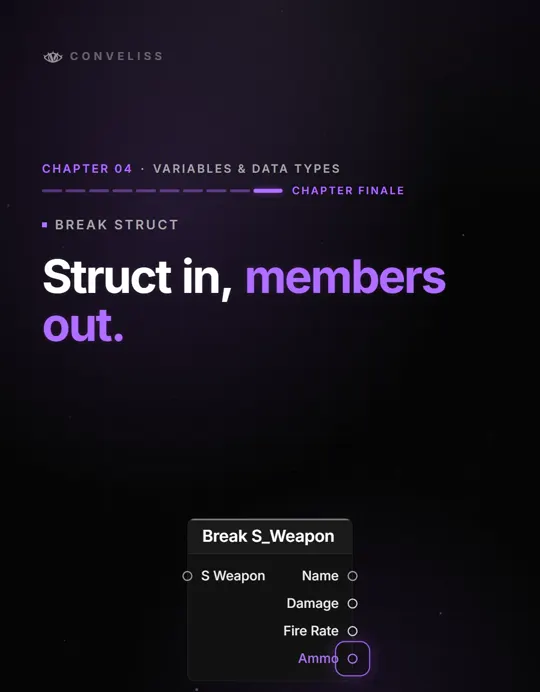
Your weapon struct holds four values. The ammo counter needs just one. Break Struct hands it over.
- 1:47 video
- Written lesson
- Beginner
Free for everyone from 5 Nov 2026, 00:00 CET
Struct in, members out
Break takes a struct in, and gives one output per member. Drag from any struct pin and search for Break, followed by the struct name.
It’s pure: no exec pins. It reads the struct every time a connected node runs.
- Too many pins? Select the node, untick unused members in Details, and those pins hide.
- Or skip the node: Split Struct Pin works on outputs too.
- Break also pairs with Make: break the old value, change one member, and make the new one.
Example: a weapon display
Current Weapon goes into Break S Weapon. Name feeds the weapon label, and Ammo feeds the counter: Plasma Rifle, twenty. Switch to the Shotgun, and the same Break now shows six rounds.
One Break can feed several nodes: the label, the counter, and the reload warning.
Break Vector, Break Rotator and Break Transform work exactly the same way.
Chapter four recap: variables and data types
- Booleans answer yes or no. Integers count, and floats measure.
- Vectors say where, Rotators say which way, and Transforms bundle both, plus scale.
- Enums allow one named state, and Switch on Enum routes each one.
- Structures group related values. Make packs them, and Break unpacks them.
Every value your game stores is one of these types, or a mix of them.
Three final tips
- AND reads both inputs, so check Is Valid with its own Branch.
- Never compare floats with exact equals. Use Nearly Equal, or less than.
- Get from an array returns a copy. Write changes back, or return a reference.
Next, chapter five: functions and collections, starting with function inputs.
In short
Struct in, members out.
Covered in this lesson
- Break Struct
- Split Struct Pin
- Make Struct
- Break Vector
- Break Rotator
- Break Transform
- Is Valid
- Nearly Equal